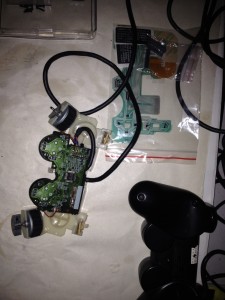
A friend had two H controllers. One was severely damaged: all buttons except the left and right sticks, L3, and R3 were nonfunctional (because years ago it was soaked in cola…). The other had L1, L2, and D-pad up and left failing, while the rest worked normally. Opening them up:
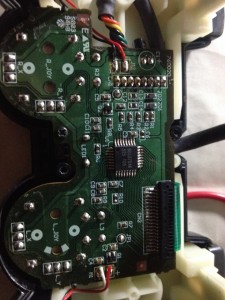
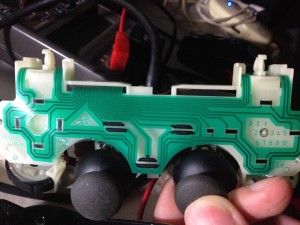
The back cover showed it was an H controller, with the board marked 760020 in white at the top left. This is the second version of the H controller. The conductive film under the button pads was marked 03-0241. On Taobao I found similar films for about 2 RMB each. Observing the connection between the board and the conductive film, I confirmed that the film connector and socket are integrated, with the socket pins soldered directly to the PCB. Comparing with my A controller, its conductive film is pressed directly onto the PCB. Taobao did not sell the original socket type film, but luckily one seller offered a similar 19-pin pluggable socket.
Looking at the PCB traces and referencing information that PS2 DS2 controllers support pressure sensitivity, the conductive film carbon contacts change resistance depending on button pressure, which the BU6370AK main chip converts into digital signals for the console. Examining the film traces, I saw that except for Select, Start, and Analog buttons, all carbon contacts shared one common line, corresponding to pin 9 from the left. Using a multimeter with one probe on pin 9 and the other on each button pin, pressing a button showed resistance changes from 0 to several kΩ (tested on the partially working controller). On the faulty buttons, it was open circuit. Comparing traces, L1, L2, D-pad up, and left corresponded to the leftmost pins, while D-pad down (which worked) was the next pin after left. So I concluded those four buttons had broken traces on the film. The other controller was worse: all buttons failed, only the analog sticks worked. Despite the cola damage, the main chip seemed fine. So I ordered replacement films and sockets from Taobao.
The biggest challenge was removing the socket soldered to the PCB. I could not find a way to remove it intact (some online suggested a hot air gun, but I did not have one, and the wide pins plus plastic housing made it risky). So I decided to destructively remove the film on the more damaged controller.
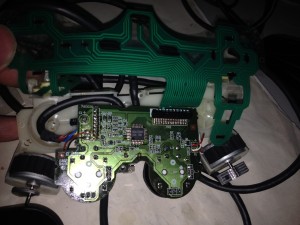
First I cut the film connector, then tried to lift the socket. Using soldering iron, flux, and desoldering braid, I managed to loosen it, but when pulling, the socket came off together with PCB copper traces:
It looked terrible, but still repairable. I prepared to use jumper wires. I positioned the replacement film and socket, inserted the film, soldered the socket ends to the PCB pads to fix it, and then painstakingly reconnected the damaged pins with jumper wires (always checking with a multimeter to avoid shorts).
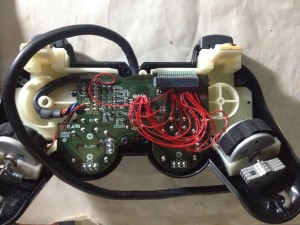
After connecting, I tested with a PC adapter. Some buttons worked, but others were stuck as always pressed. Measuring resistance again, I found the new film only had about 600Ω maximum. I suspected mismatched resistance. Referring to online advice about fixing stuck buttons, I lightly scraped the carbon contacts with a blade to increase resistance. After that, all buttons worked normally.
With this experience, repairing the second controller was easier. This time I did not cut the film, but lifted the socket and used pliers to cut the socket pins, then desoldered the remaining pins from the PCB. Unfortunately two copper traces still lifted, requiring two jumper wires. This method worked, though smaller pliers would have been better for cutting pins individually.
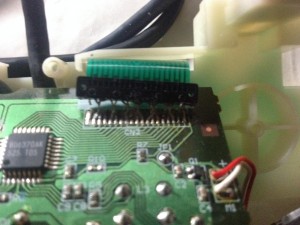
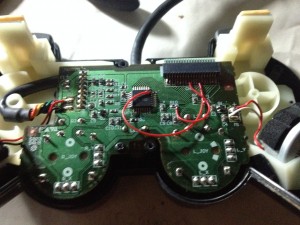
After replacing the film and socket, I expected to scrape the carbon contacts again, but surprisingly all buttons worked perfectly without adjustment. Likely the first controller was more affected by cola damage, while the second was fine.
PS: After some use, I noticed that although all buttons functioned, the pressure sensitivity was not exactly the same as the original film, especially for L1, L2, R1, and R2. Light presses were less responsive. This is probably due to differences in resistance range. Adjusting the rubber pads under the buttons might help improve sensitivity.
博主友情提示:
如您在评论中需要提及如QQ号、电子邮件地址或其他隐私敏感信息,欢迎使用>>博主专用加密工具v3<<处理后发布,原文只有博主可以看到。